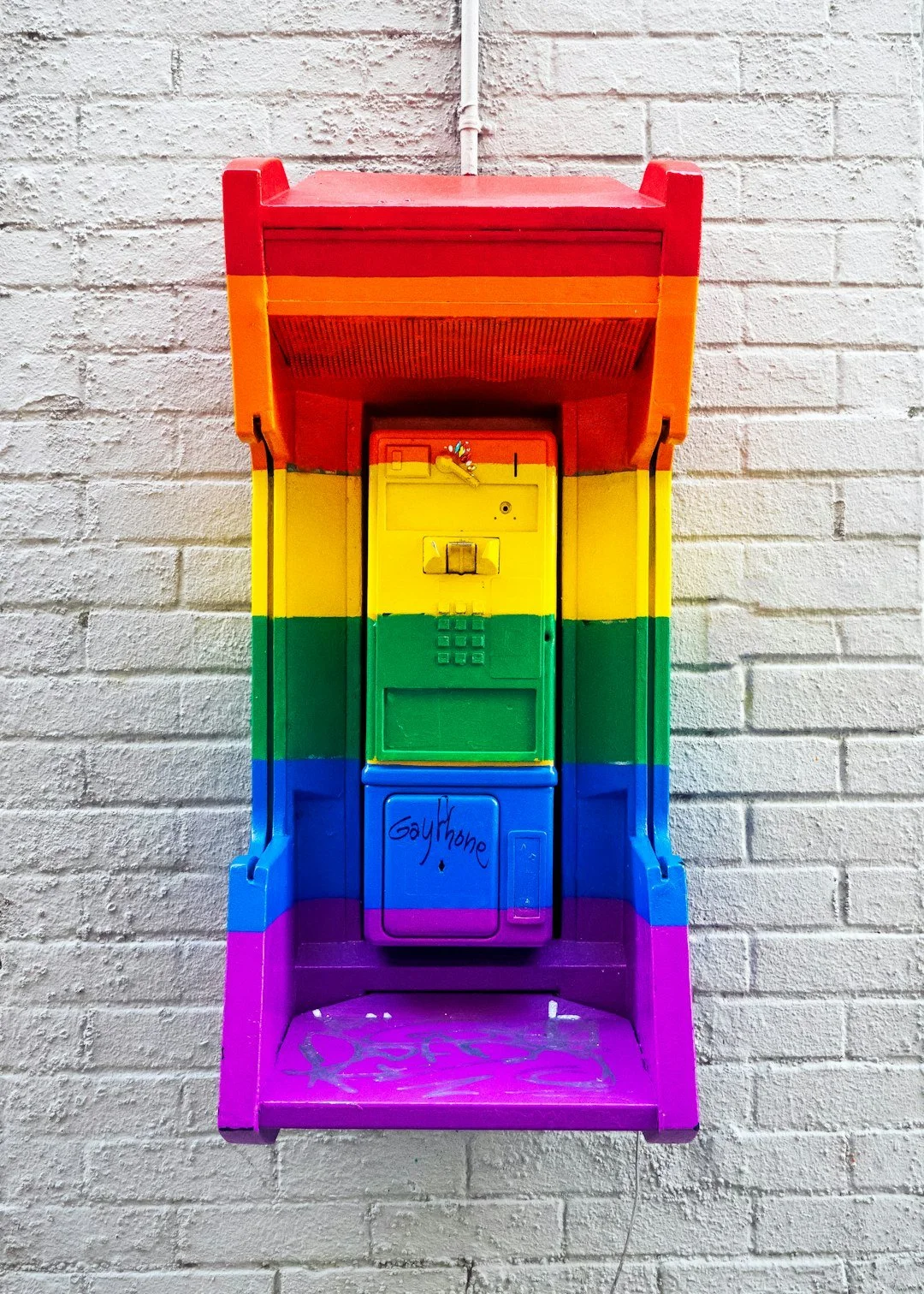
Find Me Boring
Notes from a rainy Pride, a slur on Decatur, and the quiet exhaustion of being someone else’s problem
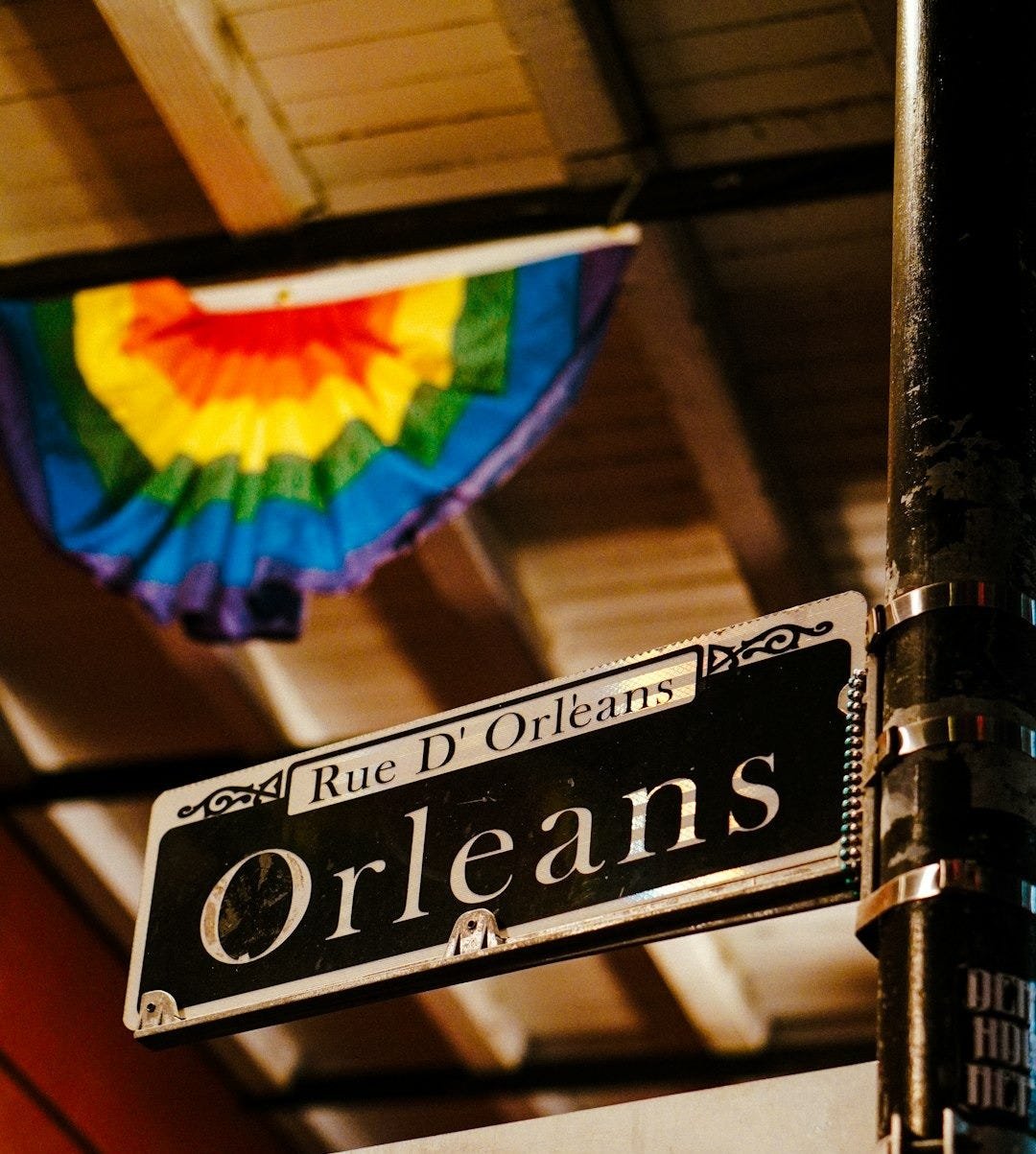
It rained the afternoon of the Pride parade, one of those warm, theatrical New Orleans downpours that empties the streets in about ninety seconds and then acts like it had nothing to do with any of it. Mabel and I had just pulled into the garage at Canal Place, so we wandered the mall for a few minutes and pretended we had come there on purpose. We ran into a couple Mabel knows from work, on their way to a birthday dinner, and we stood around talking about the weekend and what was happening in the Quarter. (This is the part people who don’t live here never quite believe. New Orleans in June, with the tourists thinned out by the heat, is a village with better food. You cannot go anywhere without running into someone you know.)
When the rain let up we said our goodbyes and headed out toward the route, hand in hand and not thinking about much of anything, since the downpour seemed to have scared most people off. A group of women passed us going the other way, laughing, narrating the street to each other. I am the less observant one in this relationship, so I caught the laughter and none of the content. Mabel caught all of it. She turned to me and said several things in Spanish that I cannot spell or repeat in polite company, because what the women actually said, as they passed the two of us holding hands on Decatur in the Quarter already turning out for Pride, was that we were slimy sinners and we were going to hell. We aired that out for a block or two, Mabel hotter about it than I was, and then the day took it back from us. The only sane answer to a stranger promising you hell on the way to a party is to go to the party.
Our first stop was Fives Bar, one of our favorites, on Jackson Square. The local artists who hang their work along the fence had folded up and fled the rain, so we picked our way around the puddles to a door kept firmly shut, as the good bars keep it in summer, holding the cold air in and the steam out. We hold our breath going in. There is no telling whether the crossed fingers and the salt over the shoulder will buy us a seat at the bar itself, which is the entire reason to go: an aged green marble countertop decorated with old-world bitters in dusty bottles, bartenders in white aprons building cocktails that are beautiful and frank about the bill to come. We were braced for it. I had what I always have, an espresso martini with lavender cream floated on top, partly because they keep the room cold enough that you can drink a winter drink in June and feel no shame, partly because they set something briefly on fire and lay it across the surface like a garnish, and mostly because the thing is, if I am honest, an alcohol infused dessert. The couple beside us had a plate of oysters that nearly broke me, but it was June, and we are old school, and we will not let an oyster past our lips in a month with no R in it.
By the time we came back out the sun had taken over again, steaming the wet pavement, and the Quarter had refilled itself in minutes. The tarot readers were back at their little tables in front of the church. The silver man on his crate had not moved through any of it, still painted head to foot in a coat of metallic paint I have never once seen drip in the heat or the rain, his basket filling with the coins of people who had finally given up trying to make him smile. We are old parade pros at this point, literally, and we know where to stand to catch a parade and maybe a strand of real glass beads, so we drifted toward the route. The rain had cooled nothing. The air was thick and warm and nobody seemed to mind, least of all the costumes, which were exactly right for the weather, by which I mean creative and scant.
The parade itself was a different country. New Orleans does not need an excuse to dress up or to stay out too late, but during Pride the city empties its whole closet. There were the Ropers, a battalion of grown men in Mrs. Roper muumuus and enormous costume jewelry, and the Stompers in their short shorts throwing themselves into choreography that makes me laugh every single year, and the brand-new mayor wrapped in rainbows and pitching beads into the crowd like it was Mardi Gras all over again. The music was good and the rain stopped mattering. The crowd ran from babies in ear protection to men who had clearly been marching at these things since long before it was safe to, and you did not have to know a single other person to be folded straight into it. We had skipped last year, and the year before that we lasted until ten before the crush sent us home, because the part of us that wanted to be in a crowd at midnight in the Quarter has quietly closed for business. So we left this time while we could still feel our feet, ceding Bourbon Street to the serious revelers and drifting home down Royal with a small stab of FOMO and a plan for a takeout pizza from Zee’s. On the way out, the two who had promised us hell were nowhere near the parade. Hate keeps to the edges, travels in pairs, and is always on its way to somewhere else, while joy takes up the whole street.
I gave it almost no thought that night. It was the next morning, coffee in hand and nowhere to be, that the whole small ugly moment caught up with me, sharper than it had felt live, and I could not set it down. Mabel and I did not arrive here young. We both ran the whole sanctioned program first, the boys and the husbands and the babies and the careers, the entire normal-young-woman starter kit, and we fell in love with women later, after we already knew exactly who we were. (I have opinions about the phrase “coming out,” and the idea that anyone should have to formally announce who they love, like filing a permit, but that is a different fight for a different Sunday.) Arriving that late handed me something I never earned: by the time the world worked up an opinion about me, I was too old and too settled to take the meeting. That is not courage, it is timing. The people I am quietly in awe of are the ones who knew at fifteen and said so anyway, into far less safety than I have ever needed, who built across hard years the steadiness that simply fell into my lap. If anyone has earned the right to be casual about a stranger on the sidewalk, it is them, not me.
I was not afraid on Decatur Street, though I have been plenty of other times, in cities and on blocks and in certain rooms where I let go of Mabel’s hand without a word, because the math of the moment says so. Both things are true at once, and an essay that gave you only the first would be lying: I am fine, and it is not always safe. What those women could not have known is how little real estate they occupy in the rest of my life. I do not picture their marriages or their bedrooms, and I do not assume their lives are smaller than mine for looking different. I judge people too, everyone does, but when I catch myself sizing up someone else’s choices I read it as a smoke detector, a sign that something in my own house is overheating and needs a check-in. They spent part of a Saturday worried about my soul, and I had not spent one second on theirs.
This turns my mind to the ever present question of acceptance. Acceptance flatters the person doing the accepting. It hands them a stamp and lets them feel generous for using it on you, as if your life were an application in their inbox. I am not applying. What I want from strangers is not acceptance but disinterest, the flat neighborly indifference I extend to whatever you eat for breakfast or do on a Tuesday. Do not accept me. Find me boring. There is no higher form of respect than the kind that does not even look up.
Thinking about acceptance inevitably leads me to the word of the month. Pride, as it is used now, is right and earned. For a great many people, claiming any pride at all meant taking it back from a world that handed them shame, and it was sometimes the thing that kept them alive. People should get to be proud of their lives and their loves, out loud and in the street, for as long as that pride is necessary, and I am not arguing with one word of it. I feel the need to confess that, for me, arriving where I did and as late as I did, the pride was never the heavy part. I love my life and I love who I love, but it does not feel like an accomplishment. A diploma is earned and a marathon is run; this is just the most ordinary true thing about me, no more an achievement than being right-handed and no more in need of applause. What I yearn for is not a better parade. It is the day none of it needs a name.
Because every movement worth anything has scaffolding. Women marched for the vote, and now nobody throws a parade because a woman filled out a ballot. People once went all the way to the Supreme Court for the right to marry across the color line, and now that is just somebody’s marriage at the next table. The whole ambition of a thing like Pride is to work itself out of a job, to come down once the building can stand on its own and not one day before.
Pull the scaffolding down too early and you do not reveal a finished building, you bring the wall down with it, which is exactly what the loud crowd now insisting the work is done is itching to start. But it is not done: a week ago the proof was shouted at me on a wet sidewalk by women who had somewhere better to be. So the day we get to set the word down is the day those women keep their salvation to themselves and I stop letting go of Mabel’s hand on streets I don’t know yet, and I would hand the parade back for that tomorrow. Until then I keep turning up, in the rain, with the Ropers and the mayor and somebody’s grandmother, glad to.
I had no intention of writing any of this. On an ordinary week, being part of this community is just a quiet fact of my life, which is the entire point and all I have ever wanted it to be. But this is a tiring season to be a person, and I keep running into the comfortable idea that Pride is a finished chapter, a success story we can shelve. That is not where we are. There are people, out loud and right now, who would take the vote back from women if they could, and they are not being quiet about it.
So I broke my own rule and wrote it anyway, mostly as a thank-you: to the people who built the scaffolding I get to stand on so casually, and to the ones still holding it up. I do not have a slogan of my own. I just have two other people’s lines that have been dancing in my head all week:
Acceptance is not a favor you do for me.
I hate the word homophobia. It’s not a phobia. You’re not scared. You’re an asshole.
Neither is mine. Both got where they were going faster than I just did. So take them, and then, if you would not mind terribly, go mind your own beautiful, complicated, none-of-my-business life. I will mind mine.