
It's Never Just Stuff: The Emotional Stages of Decluttering
It starts with a closet, and somehow becomes a full-on life review.

There’s a moment in almost every downsizing project I’ve ever worked on where the client stops, looks at me, and says some version of the same thing:
“I don’t know why this is so hard. It’s just stuff.”
It’s never just stuff.
I’ve been an interior designer for over two decades, and I stopped being surprised by tears on the job a long time ago. Not because I’m callous about it. The opposite, actually. I’ve just learned that what looks like a closet cleanout or a kitchen purge is almost always something deeper happening in real time.
People think the hard part of downsizing is the logistics. The boxes, the decisions, the Goodwill runs. And yes, that’s work. But the part that actually stops people in their tracks? The part that sends them back to the couch with the closet still open and the bags still empty?
It’s the feelings.
Over the years, I’ve noticed that nearly everyone moves through the same emotional stages when they start the process of editing their home and their life. Not in a neat, linear way. More like weather patterns. They roll in, sometimes overlap, sometimes circle back. But they’re remarkably consistent.
Knowing what they are doesn’t make them painless. But it does make them less frightening. And it makes it a lot harder to mistake a completely normal emotional response for a sign that you should stop.
Stage 1: The Surge
The Surge is the exciting part. The part that feels like possibility.
Something clicks. Maybe the last kid moved out six months ago and the silence has shifted from unsettling to clarifying. Maybe you walked through a model home or visited a friend’s beautifully edited apartment and thought that’s what I want. Maybe you’re just tired. Bone tired. Tired of maintaining rooms no one uses and closets no one opens.
Whatever triggers it, there’s a burst of energy. A conviction. I’m doing this. I’m finally doing this.
You might spend a Saturday morning pulling everything out of a guest room closet, fill three trash bags before lunch. It feels great. Productive. Overdue.
The Surge is real and it matters. It’s the momentum that gets you started. But it almost never carries you through. It gets you to the starting line. It doesn’t run the race.
I had a client, a retired professor, who called me on a Monday morning absolutely buzzing. She’d spent the entire weekend going through her home office. Books donated, files shredded, desk cleared. She was ready to tackle the rest of the house.
By Wednesday, she hadn’t touched another room.
“I opened the hall closet,” she told me, “and it was like hitting a wall.”
That wall has a name.
What to do in the Surge: Use it, but don’t trust it to last. Pick one small area you can finish in a single session and get the donations out of the house that same day. That completed space becomes your proof of concept when the motivation fades. And it will fade. The key is having a system ready for when it does.
Stage 2: The Freeze
Most people get stuck here. And honestly? Most people quit here.
The Freeze doesn’t look dramatic. It’s quiet. You open a drawer, stare at it for ten minutes, and close it again. You make a pile, second-guess the pile, put everything back. You avoid the room entirely and tell yourself you’ll get to it next weekend.
What’s actually happening is that your brain has moved from the easy decisions to the hard ones. The guest room closet was full of old coats and forgotten board games. That was simple. But now you’re standing in front of your mother’s china, or the baby blanket you knitted for your firstborn, or the set of wineglasses from a trip you took with someone who isn’t in your life anymore.
These items aren’t clutter. They’re anchors to versions of your life that mattered deeply. And your brain, which is very good at protecting you from loss, does exactly what it’s designed to do: it freezes.
I can’t tell you how many clients have described this exact sensation to me. They stand in a room full of things they logically know they don’t need, and they feel physically unable to make a decision. Not unwilling. Unable.
That’s not weakness. That’s your nervous system doing its job.
The mistake people make in the Freeze is interpreting it as failure. I can’t do this. I’m too sentimental. I’m not strong enough. None of that is true. You’ve just hit the emotional layer, and the emotional layer requires a different approach than the logistical one.
The Surge runs on adrenaline. The Freeze requires compassion. And a system.
What to do in the Freeze: Stop trying to make permanent decisions about emotionally loaded items. The Freeze happens because you’re applying Surge energy to a problem that needs a completely different approach. There are structured ways to handle the hard items without forcing yourself to decide in the moment, and without letting them stall your entire progress. That’s a big part of what I built my system around.
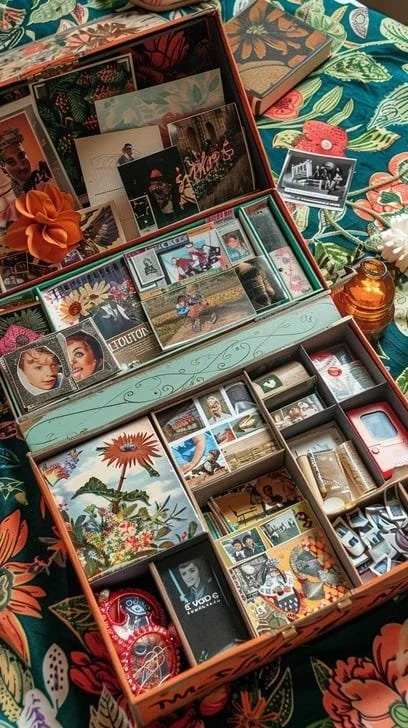
Stage 3: The Grief
I almost didn’t include this one because it makes people uncomfortable. But leaving it out would be dishonest, and I think it helps to know what’s coming.
At some point during the process, usually after you’ve pushed through the Freeze and started making real progress, something shifts. You’re not just letting go of objects anymore. You’re letting go of a life.
The house where your kids grew up. The kitchen where Thanksgiving happened for thirty years. The garden your spouse planted. The guest room that was always ready for your parents, even after they stopped being able to visit.
You might not be moving. You might just be simplifying, clearing out rooms that have become storage, making space for the life you’re living now instead of the one you lived ten years ago. It doesn’t matter. The grief can show up either way.
I sat with a woman once. Composed, sharp, the kind of person who ran a department of 200 people. And I watched her cry over a drawer full of birthday candles. Not special candles. Just the cheap supermarket kind, the numbered ones, the ones she’d stuck on cakes year after year for her kids. She had a whole drawer of leftover birthday candles and she couldn’t throw them away.
She wasn’t crying about candles. She was crying because her kids were grown, her marriage had ended, and that drawer was the last physical evidence of a chapter she hadn’t fully grieved.
We kept the candles that day. She wasn’t ready yet. Two months later, she let them go on her own terms, after she’d processed what they actually represented. She took a photo first. Wrote a few lines in a journal. Then she put them in the trash and told me she felt ten pounds lighter.
You can’t skip this stage. I’ve tried to help people skip it. They always circle back. The only way through it is to feel it, and to know that feeling it is what eventually makes the next stage possible.
What to do in the Grief: Give yourself permission to not be ready. The worst thing you can do in this stage is force decisions you’ll regret, and the second worst thing is stop entirely. There’s a middle path that lets you honor what you’re feeling while still making progress on the rest of the house. Finding that middle path is what separates people who finish this process from people who quit.
Stage 4: The Clarity
This is my favorite stage, and it’s the one that surprises people the most.
Somewhere between the tears and the trash bags, something opens up. The decisions get easier. Not because you care less, but because you’ve gotten honest about what actually matters to you versus what you were keeping out of obligation, guilt, or habit.
You start to notice a pattern in what you’re choosing to keep. It’s the pieces that make you feel something right now, not just the ones attached to a memory. The things that fit your actual life, not the life you thought you were supposed to be living.
This is when clients start saying things like:
“I can’t believe how much I was holding onto for no reason.”
“My house already feels different and I’m not even done yet.”
“I actually know what I want now.”
The Clarity stage has nothing to do with having less. It’s the moment you finally see what you have, and who you are, without all the noise.
I worked with a couple last year who had been in their home for 35 years. When we started, the surfaces were covered, the closets were packed, the garage was full. Not with junk. With life. Decades of it.
By the time we reached this stage, the wife turned to me in her living room (which now had open floor space for the first time in years) and said, “I forgot this room had such beautiful light.”
The light had always been there. She just couldn’t see it.
What to do in the Clarity: Capture it. When the fog lifts and you start feeling decisive, pay attention to what’s driving those decisions. There’s usually a vision forming underneath, a picture of how you actually want to live. Most people never take the time to articulate it, which is why the clarity fades and the freeze comes back. Getting that vision out of your head and onto paper is the single most important thing you can do to make the rest of the process stick.

Stage 5: The Rebuild
This is the part that’s actually fun. I know that sounds unlikely after everything I just described, but I mean it.
Once the excess is gone, you’re not standing in an empty space. You’re standing in a space that can finally breathe. There’s room to arrange what you kept with intention, to add one or two things that reflect who you are right now instead of who you were twenty years ago.
The Rebuild doesn’t necessarily mean buying new things, though sometimes that’s part of it. Mostly it means curating. Choosing what gets displayed, what gets stored, and how you want your home to feel when you walk through the front door.
My design brain lights up during the Rebuild, honestly. Because this is where all that emotional work pays off in a tangible way. The home starts to match the person. Things have room to shine. Rooms have purpose again.
It doesn’t have to be expensive. I’ve seen a single well-placed lamp, a fresh set of linen curtains, and three items arranged on a shelf transform a room that felt heavy into one that felt like a deep exhale.
The Rebuild is also, and this matters, where regret disappears. In all my years of doing this work, not a single client has told me they wish they’d kept more. Every single one has said some version of: I wish I’d done this sooner.
What to do in the Rebuild: Resist the urge to fill the space back up. Live with the openness for a few weeks before you add anything new. You’ll be surprised at how quickly you start to love the breathing room. When you do add something, make it count. The goal isn’t empty. The goal is curated.
So Where Does That Leave You?
Maybe you’re in the Surge right now, riding that initial wave of motivation. Good. Start somewhere easy and let it build.
Maybe you’re frozen. That’s okay too. You’ve hit the emotional layer, and what you need is a framework, not more willpower.
Maybe you’re somewhere in the middle, bouncing between progress and grief, between clarity and confusion. That’s the most common place to be, and it doesn’t mean you’re doing it wrong.
Wherever you are, all of it is normal. The tears, the stalling, the standing in a room wondering why a set of birthday candles can undo a perfectly competent adult. It’s all part of the process, and the process works. If you let it.
Where to Start
If any of this felt familiar, I put together a free guide that walks through the psychology behind why we hold on to things and how to start making decisions without guilt or regret. It’s the same framework I use with clients before we ever pick up a box or open a drawer, because the inner work is what makes the outer work stick.
It’s called The No-Regret Foundation, and it’s 45 pages of the stuff I wish someone had told me (and my clients) years ago. It also introduces something I call the 50% Rule, the single most useful decision-making framework I’ve found for this process. It’s the reason my clients don’t end up regretting what they let go.
Download The No-Regret Foundation: Free
If you’re in a season of editing your home and your life, this is the place to begin. And if you recognized yourself in any of these stages, I’d love to hear which one.