
Stuck in Decluttering Overload? Five Moves To Hit The Restart Button.
Five practical tactics I use with clients when motivation runs out, and the project feels too big.
I’ve spent the last few months writing about the emotional side of decluttering. The stages. The grief. The way a drawer of birthday candles can undo a perfectly competent adult. I stand by all of it.
But a few of you have written back asking some version of the same question:
Okay. But what do I actually do?
Fair.
Here is what I tell clients when they’re frozen in the middle of the living room, needing something to break the spell. Five tactics. You can pick one and off you go. The point isn’t to do all five this weekend. Doing any one of them will probably get you to the next one.
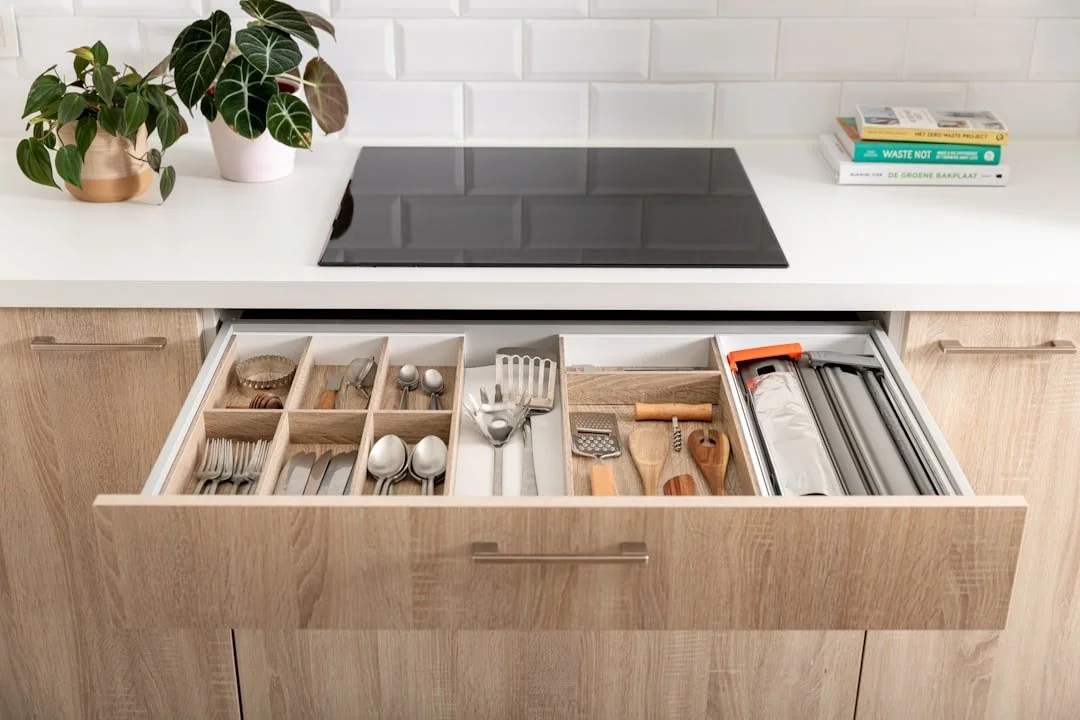
1. Pick a single drawer. Not a room.
The room is not finishable. The drawer is.
I cannot tell you how many clients have called me on a Sunday evening, sitting in the middle of a half-emptied closet, surrounded by piles, unable to make another decision. They started with a closet because the internet told them to start with a closet. By 4 pm, they were spent, and the closet looked worse than when they began. The time-worn phrase, ‘It is always darkest before the dawn,’ comes to mind.
The drawer works because the drawer ends. You can finish a drawer in twenty minutes. You can finish a utensil bin over coffee. You can finish the basket of cords nobody has touched since 2019.
The goal of the first session isn’t progress in square footage. It’s proof. Proof that you can start something and finish it, and that the world does not end when you throw away the broken corkscrew. I am a sucker for a checklist, and I love checking the boxes on it, no matter how insignificant that line item might be.
One small thing that makes the drawer count: schedule the donation drop-off before you start sorting. Bags by the front door become furniture within seventy-two hours. Maybe there is nothing to donate, hit the trash barrel before you go to bed. If you can’t get it out of the house, you didn’t really get rid of it. You just moved it.
Pick the smallest possible container of stuff in your house. Start there.
2. Don’t sort anything until you can describe the life you’re sorting for.
This is the one that takes the most convincing, because it sounds like procrastination. It isn’t.
Most people walk into a closet and start asking, do I keep this? That’s the wrong question. The right question is, does this belong in the life I’m building? You cannot answer the second question if you have never written down what that life looks like.
I had a client a few years ago who couldn’t get rid of any of her books. We sat in her library for an hour and got nowhere, because every book had a reason to stay. Then I asked her to tell me what she wanted her mornings to feel like in her new condo. She thought about it and said, I want to read in a chair by a window with the city below me. Just one book at a time. The kind that makes me think.
Suddenly, the business books from 1998 weren’t on the keep list. Neither were the novels she’d already read twice. The library shrank by half in an afternoon, not because we got more ruthless, but because she finally knew what she was keeping things for.
This is the work the course (information below) front-loads before the sorting starts, and it’s the work that makes the sorting actually possible. You don’t need the course to do it. You need twenty minutes and a notebook. Write down how you want to feel in your space, what you want to do there, who you want to invite, and what kind of mornings you want to wake up to. Specific. Detailed. Not aspirational, actual.
Then go sort.
3. Use the 50% Rule.
This is the one I lean on hardest with clients. It’s the framework that does the most work for the least effort.
The rule is simple: in each category, you’re keeping the best half. Not the necessary half. The best half. The pieces that fit who you are now, that you reach for first, that you’d buy again today if you saw them in a store. The other half goes.
I tracked this with clients for years before I trusted the number. People who reduced their belongings by about half reported 89% satisfaction two years later. People who went harder, reducing by 70% or more, reported 34%. Most of them started replacing things within the first year.
Half is the sweet spot because it’s enough to clear the visual and mental noise without making the space feel sparse. You’re not minimizing. You’re curating. The difference matters.
When you’re agonizing over something, the question isn’t can I bear to let this go. The question is, is this in my top half of this category? If you’re not sure, it isn’t.
4. Build a Purgatory Shelf.
For the items you genuinely cannot decide on. Not everything. Just the few that have you stuck.
One shelf. Not in the room you’re working on. Somewhere out of the way. The basement, the attic, the back of a hall closet. Items go on the shelf for twelve to eighteen months - less if you are on a time crunch because you are moving - one month is usually enough. No exceptions, no extensions, no negotiating with yourself when the date arrives.
If something comes off the shelf during that window because you actually wanted it, it earns its way back into your life. It stays.
If it sits there untouched for a year and a half, you have your answer. Donate it without opening the box (crucial advice).
Most things quietly fail this test. The fondue pot from the 1985 wedding registry stays on the shelf. The platter you forgot you had comes off the shelf in November and hosts Thanksgiving. The system sorts itself if you let it.
The Purgatory Shelf is not a cheat. It’s a way to keep moving when the alternative is freezing entirely.
5. Take a photo before you let it go.
The photo is the bridge.
This is the tactic that surprises people the most, because it sounds sentimental and it is, but it works for a deeply practical reason. The thing you’re trying to hold onto isn’t the object. It’s the memory the object carries. Once the memory has a place to live that isn’t your closet, the object is free to go.
I had a client a couple of years ago who kept an entire drawer of leftover birthday candles. Cheap ones. Numbered ones. The supermarket kind. She’d been sticking them on her kids’ cakes for decades, and she could not throw them out.
We didn’t make her. We photographed them, all of them, in a few frames. She wrote a couple of lines in a journal about what they meant. Then she dropped them in the trash and told me she felt ten pounds lighter.
The photo isn’t a workaround. It’s the actual point. You’re not throwing away the years. You’re choosing where to keep them.
Pick one this weekend.
That’s it. Not five. One.
Pick the drawer. Or write the vision. Or photograph the thing you’ve been circling for six months and finally let it go.
If it works, you’ll know what to do next. And if you find yourself wanting the full system — the frameworks for the hard stuff, the prompts for the conversations with adult kids about who wants the china, the way to think about what to keep when you’re moving from a four-bedroom house to a two-bedroom condo — that’s what I built Clutter to Curated (👈 click the link to the course) for. We also have a fun assessment-type quiz (👈 click here for the free assessment) if you want to dip your toe in and see where your decluttering dreams need to go next.
It’s $97, it’s self-paced, and it’s the same system I use with clients. Translated into something you can work through at your own kitchen table. Without me there.
But you don’t need it to start. You need a drawer and twenty minutes.

Clutter to Curated: Declutter & Downsizing Course 👈 or Free Assessment Quiz 👈
Do you have a declutter blind spot? I would love to hear where you get stuck and how you get unstuck!