
The Fountain (Part 2)
A night in a French Quarter courtyard, and the stories old houses keep
This is the second and final part of The Fountain. If you missed Part One, you can read it [here]. Otherwise, we left Elle in the courtyard, having just spent twenty quiet minutes by a fountain with a young couple who turned out not to be where she left them. The rest of the story begins now.
I found Camila in the kitchen, deep in a glass of something Benoit had pulled out of a corner of the refrigerator, with the air of a woman who had decided she lived here now. I wandered over, and Lucinda was at the island when I arrived, slicing a lemon for somebody with the unhurried efficiency of a hostess two hours into her own party.
Lucinda, I said. I want to tell you what a lovely night this is, and how grateful we are to be here.
She gave me the warm, luminous smile I had come to expect from her, especially when she was in her element, entertaining the people she most cared about.
I met the loveliest young couple by the fountain, I said. They seem to have disappeared into the crowd. They said they had known your family forever. Old neighbors, they said. I thought you’d want to know how charming they were.
Lucinda’s face did a small thing.
It was nothing, really. The corner of her mouth caught a half-question that didn’t quite form. Her eyes flickered toward the courtyard, then back to me, then back to the lemon. Old neighbors, she said, as if turning the phrase over to see if it fit, in a sort of distracted way.
Maybe I have the wrong impression, I said quickly, because I had clearly stepped on something. I’m terrible with names, you know that. Maybe they were guests of guests. There are so many people here.
That must be it, she said, and she smiled at me, and the smile was warm but it had a small distance in it. The lemon was finished. She moved on with the platter. The moment closed.
Camila glanced at me as Lucinda walked away. What was that about?
Nothing, I said. I’d had a lovely chat with someone and wanted to compliment Lucinda on her guests. I think I confused her.
Camila shrugged and refilled my glass.
I went looking for the powder room.
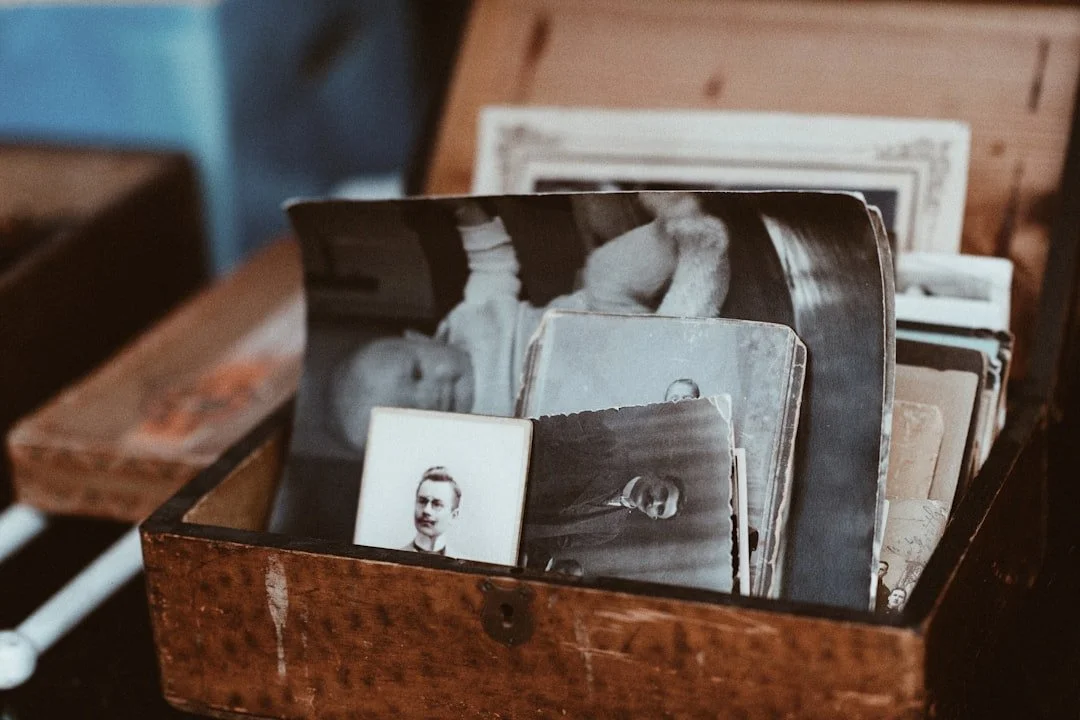
There was a small hallway off the kitchen, an in-between space that old houses tuck themselves into and forget about. Lucinda had not forgotten about it. The walls had been freshly painted a deep, almost-burnt coral-colored lacquer, and along the length of the hallway, in a neat double row, hung a collection of old family photographs in matching black frames. Sepia, mostly. A few of them in the cool blue-grey of early color. They were beautifully arranged; the gallery wall a woman with a former lawyer’s eye and a Manhattan apartment’s worth of taste would compose without thinking too hard about it.
I stopped to look. I always stop to look at family photographs. It is one of my failings as a guest and one of my virtues as a writer. But really, if people don’t want you to stop and be nosy, they should not display photos near the powder room.
There was a wedding portrait from what must have been the 1940s, a young woman with dark eyes and a gardenia in her hair. There was a christening, a baby in a long lace gown held by hands I couldn’t see the rest of. There was a faded photograph of two little girls in matching pinafores standing on a porch I half-recognized as the front steps of this very house. There were beach photographs, vacation photographs, a horse, a Christmas tree, and a man in a uniform from a war I couldn’t identify.
And there, near the middle of the wall, was a photograph of the young couple from the courtyard.
I lifted it off the wall before I knew I was going to.
It was a portrait, formal, the way people sat for in the 1920s, when a portrait was an event. They were both in their twenties. She was wearing the long pale dress she had been wearing tonight, or one very like it, and her dark hair was pinned up the same way. He was in a suit, with the same dark eyes and the same quiet courtesy in his bearing. They were standing close, not touching, but you could feel from the way they held themselves that they were holding back from touching. They were both looking at the camera, and they were both smiling, as if they had a secret plan.
I turned the photograph over.
In small, faded handwriting on the back: Nico and Celeste, 1924.
Nico and Celeste. The names landed in my chest before they reached my head. Of course. Those were the names they gave me, I thought, now I remember. I had filed them by her hand on the fountain, and his small nod.
I held the photograph for a long time. Long enough that I heard a peal of laughter from the courtyard, the swell of music from somewhere, and Camila laughing in the kitchen. Long enough that the corners of the photograph went warm against my fingers.
This is something people do now, I told myself. They take photographs and process them to look old. I think you can even have it done when you visit Frontier Land at Disney World. They print them on textured paper, frame them in vintage frames, and hang them as a joke. It happens. Maybe Lucinda had done it. Maybe one of her children, maybe a friend. It’s possible.
I knew it wasn’t that.
I looked back through the doorway, past the kitchen, toward the courtyard. The fountain was just visible from where I stood, dark and round, bubbling and complete with lily pads, at the far edge of all that lamplight. Her hand had been on it the entire time we talked.
I put the photograph back on the wall. Carefully. Exactly as I had found it. The card beneath it, in Lucinda’s clear modern hand, said: Lafont family, c. 1924. Identities unknown.
I went to the powder room. I closed the door. I leaned against the sink for a minute, not trusting myself to look in the mirror. I waited until I could trust my face to go back to normal again.
We said our goodnights in the courtyard. I had to force myself to be present for a few more minutes. The courtyard was still humming but had begun to soften, the hour when the wine has done what the wine is going to do, and people start to think about tomorrow. Aimee hugged us both. Lucinda hugged us both, and the strange small distance of the kitchen had passed, or she had decided to let it pass, and her hug was warm and full. Hank kissed me on both cheeks. Margaret made me promise to come to her house for lunch sometime, which I would not, of course, and which she would not remember asking me, and we both knew it and didn’t mind.
The Quarter was different now than it had been when we arrived. The bars were full, the streets were full, music came out of doorways that had been quiet at eight. We threaded back through the residential blocks toward Rampart, found the car where we’d left it, and put the windows down to let the soft evening air in.
I drove home. Camila is the better driver in our marriage, but she had been on the wine-tasting trail around the kitchen with Benoit, and I had been shocked into sobriety by what I had found in the hallway.
That was a wonderful party, Camila said.
It was.
Did you hear all that about the diamond? she said.
I had not been expecting her to say that, and I felt a small startle in my chest that I hoped she didn’t catch.
I heard some of it, I said. The man in the parlor was telling it.
I heard a different version, Camila said. From a woman in the kitchen. The Connecticut one, the one with the agricultural friend. She said the diamond was won by the grandfather.
The pumpkin-plaid man said the stepfather.
Right, right, but nobody seems to know whose stepfather exactly. Camila waved a hand, the way she does when she’s piecing something together out loud. I think, from what I heard, there was a card game somewhere in the early twenties. He was a card shark, this grandfather, or stepfather, or whoever. He won an enormous diamond from a man in the mafia, which was a bad idea even then, and the man killed him a few weeks later – he wanted his diamond back. The diamond was never found. Some people in the family thought he was buried with it. Some people thought the murderer had taken it back. Some people thought he’d never really had it at all and was bluffing the whole night.
That’s roughly what I heard, I said.
The grandmother and the mother were always cagey about it, the woman told me. They’d hint at things and then change the subject. The family never agreed on which version was true.
The secret was buried with the stepfather/grandfather, I said, repeating something I had heard somewhere that night, I couldn’t remember where.
That’s the line, yes.
We drove for a while. Down Rampart for a minute, Esplanade was quieter. The moon was up over the river, and the air smelled of jasmine from yards I couldn’t see.
Funny how every old Southern family has a story like that, Camila said, and nobody ever quite remembers it the same way.
Funny, I said.
We turned onto our street. Camila reminded me to slow down for the cat that lives at the corner.
The young couple by the fountain looked sweet, she said.
I did not say anything for a beat. Then I said, Yes. They were.
I liked her dress, Camila said. Very vintage. She had that whole look.
The cat was not in the road tonight. I kept driving.
I did not ask Camila what she had seen. I did not ask her how clearly she had seen the couple. I did not tell her about the photograph. I sat in the driver’s seat with my hands on the wheel and watched the houses go by and tried to settle the thing that had risen in my chest.
We pulled into the driveway. I turned off the car and looked at Camila.
You’re quiet, she said.
I’m tired, I said. It was a long day. Very fun but long.
She believed me, or she didn’t, and either way she let it go.
I could not let it go, even if everyone else had.
I started a few days later, the way I always start things, with too much coffee at my desk while the house was still quiet. I went to Ancestry first, of course, anyone would. The Lafont family came up almost at once. Henri Lafont, born 1880, died 1924, cause of death listed simply as a fall. Married first to a woman named Marie, who died in childbirth in 1902. Married second to a young woman named Isabel in 1922. Survived by a daughter, Celeste, born in 1902 from the first marriage. Survived by a posthumous daughter, Madeleine, born to Isabel in 1925. Madeleine, of course, was Lucinda and Aimee’s grandmother. The skeleton of the family was there for anyone who knew where to look.
Celeste’s record was the strange one. Born in 1902, then nothing. No marriage, no death, no further trace. Only a 1924 missing-persons listing, dated October, and then a silence that never resolved.
The Times-Picayune archive gave me three paragraphs from October of that year. Miss Celeste Lafont of the French Quarter had been missing since the previous Tuesday. The family declined to comment beyond noting that she had gone to visit relatives in Mobile. Two weeks later, a smaller article reported the recovery of a young man’s body from the river. Nicolo Marino, age twenty-three, of a Sicilian-American family in the Quarter. The article did not connect the two cases. There was no reason it would have. The Lafonts and the Marinos lived in different worlds, and the police of 1924 New Orleans were not in the business of building bridges between the disappearance of a respectable young woman and the death of a Sicilian boy from the river.
The Historic New Orleans Collection had the police inventory. Personal effects of Nicolo Marino, October 1924. A watch. A wallet with seven dollars. A folded letter. The letter itself was not in the file, but the inventory had transcribed a single line for the record: signed “my love,” addressed “my love,” concerning travel arrangements.
That line caught me. My love. Not a name. Not signed C., not addressed N., the way a 1924 letter from a young woman of the Lafont family to a young man of the Marino family might have been if either had been careless enough to put names down. They had not been careless. My love could have been anyone, written by anyone, found in any pocket. The police had logged it and let it go.
The librarian was kind enough to let me see the photograph of the inventory page. The handwriting was small and steady, a young woman’s hand. Most of it was practical. Times. A boat. A meeting place. One sentence near the end I have not been able to forget.
The bright thing is hidden in the place I love best in this house. You will not have to ask me where.
I read it twice. Three times. The bright thing. Bright is what people called diamonds when they did not want to call them diamonds. The bright thing in the place she loved best. I thought about it on the drive home from the archives. I thought about it for weeks. I had no idea what place she had meant.
Aimee asked me to lunch a few months later, at a small place in the Marigny that does not take reservations and only seats fourteen.
We talked about her children. We talked about the renovation of Lucinda’s house, which had moved on from the side parlor to the master bath and was now in the phase where the contractor stopped returning calls. We talked about Camila, who had become Aimee’s particular favorite among the in-laws and was returning the compliment. We were halfway through our salads when I mentioned the fountain.
I love that fountain in Lucinda’s courtyard, I said. That cauldron with the cherubs. Did Lucinda find that somewhere, or was it always there?
Oh, that’s the fountain, Aimee said. That’s our grandmother’s fountain. Or our grandmother’s mother’s. I always forget which generation moved it. It used to be in the middle of the courtyard, you know, where it should be. And then sometime in the twenties, our great-grandmother had it taken up and moved over near the back wall. Same time she had the wall rebuilt and made taller, with the broken bottles on top. The story we always heard was she’d had a problem with people climbing in. The Quarter was rougher in those days.
Was that Isabel? I said.
Isabel, that’s right. My grandmother. I never met her. She died long before any of us were born.
I looked at my salad. I had a forkful of frisée halfway to my mouth.
The fountain was moved over to the back wall in the twenties, I said, slowly, the way you say something to be sure of it.
Yes. Why? Are you thinking of doing something like that at your house?
No, I said. I just love the way it sits there. The way it’s a little off-center. I always wondered why.
Now you know, Aimee said, and laughed, and refilled my wine.
I did not say what I was thinking. I did not say that I had finally understood what the letter had meant, after weeks of carrying the line around with me like a stone in my pocket. I did not say that the bright thing in the place I love best in this house meant a fountain. I did not say that Celeste’s hand had rested on the rim of that fountain the entire time we talked, the way a person rests a hand on a thing they have known a long time. I did not say that Isabel had moved the fountain over to where her stepdaughter had hidden the diamond. Isabel must have known, somehow, the maid must have told her, and had buried the diamond deeper underneath the new fountain spot, and had built up the wall to make sure no one could come back over it. Isabel had spent the rest of her life tending a fountain that was a grave marker. None of her children had known. None of her grandchildren had known.
I finished my salad. Aimee told me about a new restaurant in the Bywater. We split a flourless chocolate cake. I drove home in the bright afternoon and sat on my couch for a long time afterward, not doing anything in particular, while the dogs watched me with the patient curiosity dogs reserve for humans who have stopped moving.
That was the day I started writing the book.
A year and a half later, I sent Lucinda a copy.
I had written it slowly, over many mornings, with the kind of patience I had learned only late in life. It was a small book. It was a ghost story. It was set in a French Quarter house with a wall instead of a front yard, on a residential block where not many tourists came looking, and it starts on a Saturday night after Jazz Fest in May.
I titled the book Tales from the Quarter. The first story is about a fountain. I changed enough of the names and details to respect the family's privacy, but I had not changed everything, and Lucinda would know what she was reading the moment she opened it.
I wrote her an inscription on the title page. It said:
Lucinda - Thank you for the most magical evening of last year’s Jazz Fest, and for the lovely welcome into your home and into your family. This book is mine, but its heart is yours and Hank’s and Aimee’s and Benoit’s and the courtyard’s. With great affection, Elle.
I mailed it on a Wednesday.
I do not know whether she read it. I do not know whether she noticed that the photograph in the hallway had a name in the story it does not have on the modern card beneath it. I do not know whether she ever turned the photograph over.
I do not know whether anyone has touched the fountain.
What I know is that on the night I sent the book, I sat for a long time in our courtyard at home, where Camila was reading something on her phone and the dogs were asleep at her feet, and I thought about a young woman who had rested her hand on a fountain for a hundred years and was finally on a page somewhere that someone living might one day read.
That seemed, for the moment, like enough.
Thank you for coming on this evening with me. The Fountain is the first of what I'm tentatively calling Tales from the Quarter. Whether there will be more depends on whether more arrive. If this one stayed with you, I'd love to hear about it in the comments.